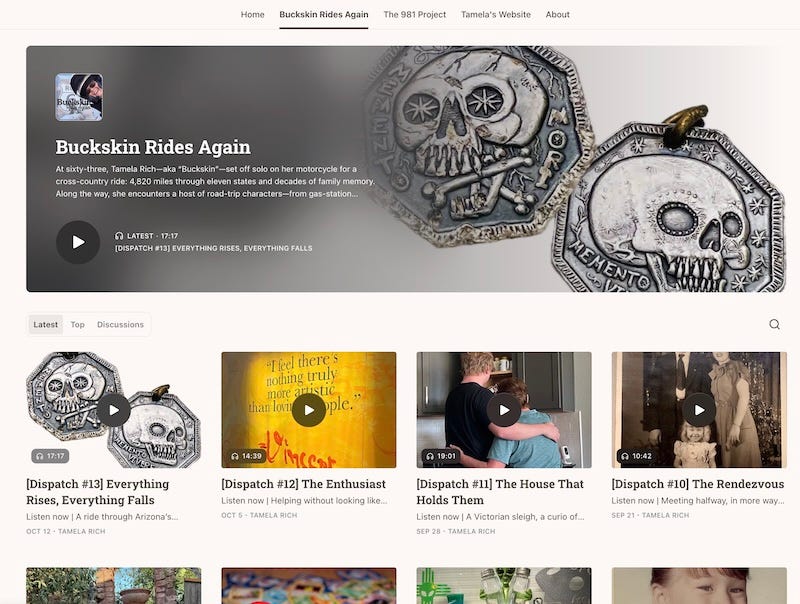
This week finds us past the halfway point of Buckskin Rides Again (a serialized memoir). We’ll cross the finish line on January 4, 2026.
After years of writing, I’ve noticed that some stories arrive politely, tapping me on the shoulder. Buckskin was not one of them.
My muse grabbed me by the throat—not to silence me, but to make me drop everything else and listen. At first, she whispered that I should “write about the journey,” and as a veteran travel writer, that made perfect sense. But that was just the camel’s nose under the tent.
She had deeper work in mind for me and for that story.
Every one of those 4,820 miles to Arizona and back asked me to look again—at myself, my family, our history, and the inheritance I hadn’t examined closely enough.
Since I know some of you are interested in how a project like this comes together — whether out of curiosity or because you’re thinking about writing a memoir yourself—here’s a peek behind my creative curtain.
Note: This is Part One of a two-part series. Today I have three steps to share.
First, Write Something. Write Anything.
I’m a half-diligent journal keeper—I write in fits and spurts—but I always keep notes during a trip, even if just a line about weather or the route I took.
Those little scraps turned out to be gems: smells I’d forgotten, snatches of conversation I overheard at a café—details that evaporate if you don’t catch them in the moment.
My first step was simply transcribing those handwritten notes into Google Docs. Once I started typing, I added to the journal notes little snatches of memory from childhood or something I looked up, like the history of a place I had passed through. For example, I didn’t know that the Ouachita Mountains ran east to west—unlike the north-south spines of the Appalachians and Rockies—until I started writing about my time in the Ozarks and looked it up.
I’ve been learning that transcription is like priming a pump: once the water starts to flow, it keeps going. Eventually, one image or scene triggers another, and I found myself free-associating the trip with fragments of childhood, marriage, motherhood—and all the stories my family has told for generations (like Papaw being an itinerate pony photographer).

If you need some writing prompts to help you prime your own memory pump, I’ve provided a set of them in each Buckskin dispatch.
There are many ways to begin a memoir. My approach is intuitive at first; I don’t start with charts or systems. I start by feeling my way through what wants to be written. Only later do I shift into a more analytical mindset. Sometimes I think getting analytical too soon can cut into your creative process, but your mileage may vary.
Step Two: Start Noticing and Take Inventory
Once I had all my notes typed up, I shifted from writing to reading—not to polish my prose (there wasn’t much to polish anyway), but to observe patterns.
I highlighted key words, weather details, recurring images, names that kept reappearing, and phrases that hummed a little louder than the rest. The purpose of this inventory is to see what shows up again and again, because that’s the memoir’s deeper subject.
Here’s what I mean by that. On the surface, Buckskin is about a trip. At a deeper level, I noticed that I was also writing about wind and weather, wayfinding and range—about competence, risk, and the work that traveled with me.
I kept circling themes of family and care, patience and waiting, handmade hospitality, and the rough poetry of American places.
There were also the smaller but steady motifs: visibility and aging, roadside eateries, hotels, motorcycle maintenance, planning, and checking in—both literally and emotionally.
To me, this first-level analysis is like looking in the pantry to see what ingredients you have on hand. Only then can you make a list of what’s missing—or what you need more of—to finish the cake.
This is when the writing began in earnest for me. I wasn’t sure if I would keep the road-trip framework, but it gave me an easy entry point—and that’s all a writer needs at this stage. Anything to start writing.
Writing is about writing. Whatever makes it easier is what you need to do first. Everything else—structure, reorganization, refinement—belongs to the editing phase.
Write first. Write crap. Write. Momentum matters more than elegance at this point.
When I knew what ingredients I had, I needed to understand how they worked together—where the flavors balanced and where something was missing. For someone else, this might remain an intuitive process, but I had to bring in extra tools since I’m pretty balanced between my right and left brains.
Step Three: Analyze What You’ve Written
Once I had something more than notes—an essay, a dispatch, a few scenes that are starting to breathe—it’s time to shift from pure writing to analysis. I needed a way to see how the pieces related to one another: which memories belonged together, which scenes carried the same emotional temperature, and what gaps were still waiting to be filled.
Patterns don’t just reveal themes—they reveal who gets centered and who gets left out, which becomes an ethical question later.
Enter the spreadsheet.
At first it was just a list of working titles and word counts. Then it expanded to became a log of dispatch synopses, with a column for symbolism. Eventually, that humble spreadsheet became my map—not just of mileage, but of meaning. And memoir is always about meaning.
It started as a practical tool, but it taught me to see patterns I hadn’t noticed before—emotional peaks and lulls, where I lingered on my mother too long or skipped over my father’s storyline. That kind of awareness, though, belongs to the next layer of the process, which we’ll explore in Part Two.
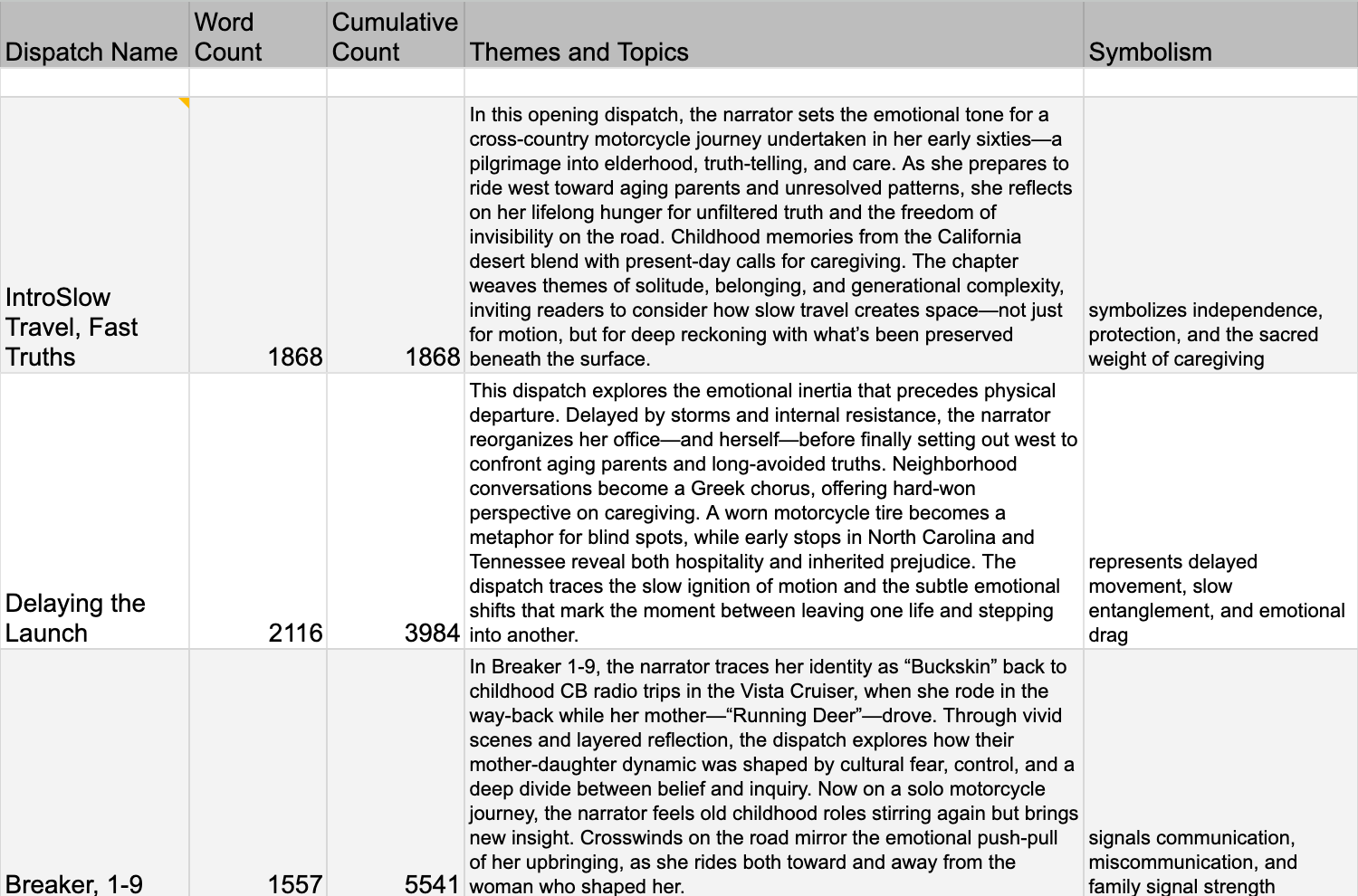
Now, I’m going to open a can of worms with this next suggestion: you can get a little help with this spreadsheet from an AI. I uploaded excerpts and asked it to highlight repeated metaphors or recurring emotional tones.
I’ll give you a moment to clutch your pearls and catch your breath.
I know—controversial territory. But used thoughtfully, it’s like having another pair of eyes scanning for patterns. As a bonus, the AI might notice themes or symbols that slipped right past you. It certainly happened in my case. We all have our blind spots.
No, it’s not cheating to use an AI any more than turning it over to a friend or editor to read or analyze. It’s collaborating. When used ethically, AI can serve as a kind of helpmeet—a thinking partner.
The discerning human (that’s you!) still has to do the storytelling.
This is the first of a two-part look behind the Buckskin dispatches.
Today’s post covered the how—the systems and habits that keep the story moving. In Part Two, we’ll turn to the heart of it: deciding what belongs on the page, what to hold back, and how to balance truth-telling with tenderness.
Memoir is a tricky genre. Writers face a steady stream of ethical choices about privacy, portrayal, and emotional honesty—and we’ll dig into those next time.
That’s where I’ll leave you for now—before this post turns into its own spreadsheet.
Since you’re the reason this whole serialization works, I’d love to hear what’s resonating most (and least) for you about Buckskin Rides Again. Your answers will help me decide how to shape the second half of the series—and the eventual book.
One of the great advantages of serialization is that it lets writers listen as they go. So I’m listening. You can either hit Reply or comment, or use this handy poll.
Quick Poll: What keeps you reading?
Every reader comes to Buckskin for a different reason—some for the road, some for the reckoning, some for the ride-along storytelling. What’s your favorite stretch so far?
I can’t wait to see what your poll responses reveal—it’s like giving me peek inside your helmet for a moment. Your insights might even shape the way I frame the final dispatches—or what I explore next.
I’ll share the results next time when we head into Part Two: Truth, Tenderness, and Telling It Anyway.
If you have Spotify or Apple Podcasts, you can listen to all the dispatches there, or at this link.
Read or listen to all prior dispatches here