


My book club just read the short story collection by Jess Walter, The Angel of Rome and Other Stories, which includes a scene where an elderly couple is arguing at a restaurant: talking past each other, trying to get the last word, and settling old scores. You know, real human interaction.
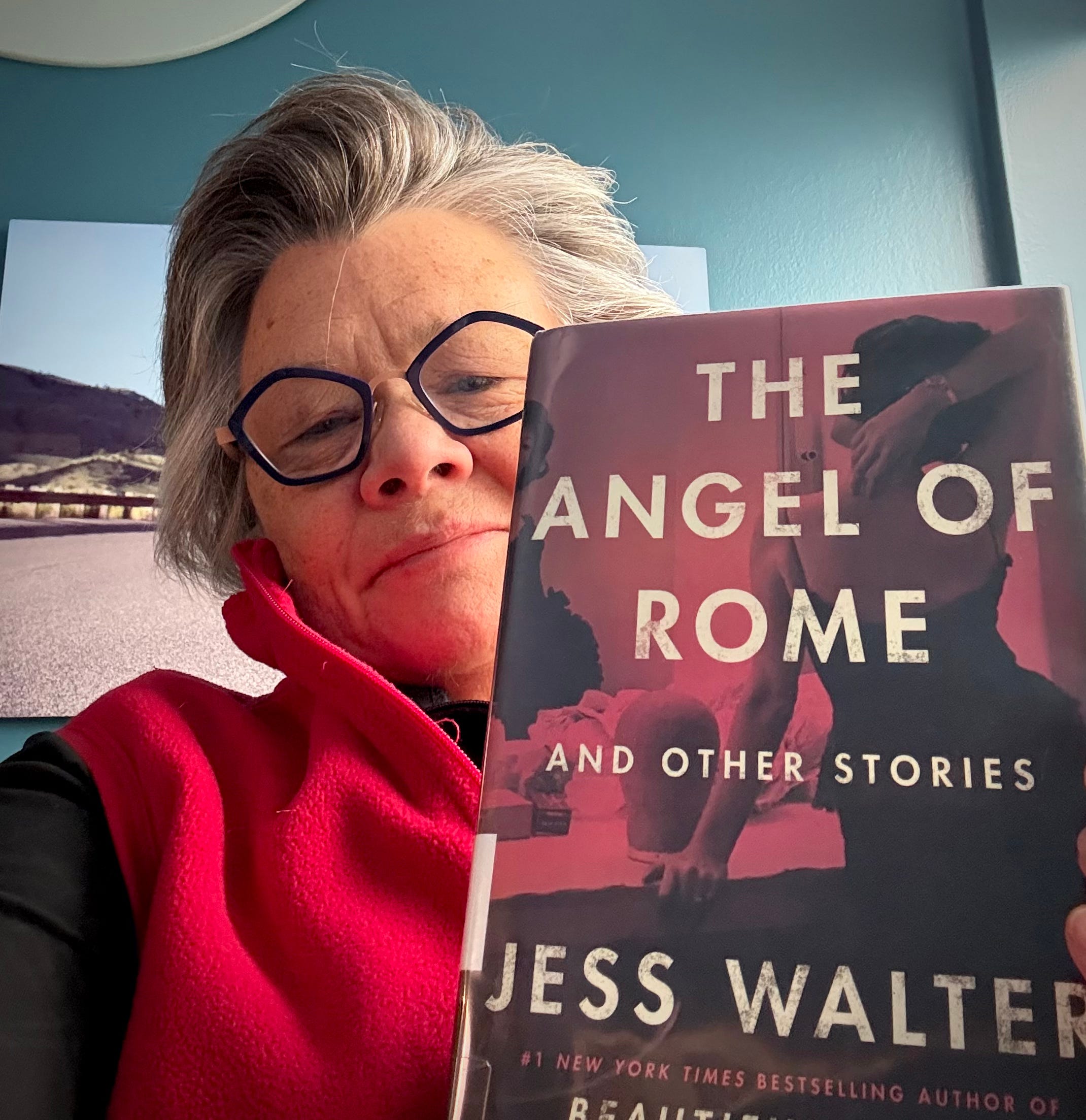
At a certain point, the man notices an earnest-looking younger man at a nearby table scribbling frantically in a notebook. It occurs to the older man that the younger one is transcribing the argument and he turns his ire from his wife to the eavesdropper.
Turns out, the eavesdropper is a grad student completing an assignment to observe people, write down their conversation, then create a story around it. Most of us writers have had that assignment: sit in public, listen carefully, write it down, then make something from it. This trains the ear. Teaches restraint.
Sometimes it also prepares you for listening when a situation presents itself without invitation, as it did for me one fall evening in our condo’s community room.
There were seven of us sitting on the sofa and club chairs as we small-talked, passing the time while the sun sank beyond the slats of the plantation shutters. A woman who doesn’t live here year-round came in and changed the group equilibrium. We wanted to be gracious and make her feel included while not allowing the conversation slide into HOA matters, which is where she usually points the ship.
Someone reached for common ground and asked if Costco had started carrying Firehook Flatbread crackers, a specialty brand from out of state. What followed was a kind of conversational pile-up—people talking past one another, questions stacking without answers, and coherence dissolving in real time. Here goes:
What are Firehooks? Does Lance make them?
Lance? Are they like Lance with cheese?
Did you say Ritz? Ritz with peanut butter?
Firehooks come with cheese?
No, they are flatbreads.
Are they flat?
Yes, they are flatbreads.
What about the kind with crunchy peanut butter?
Did you say Lance?
What’s wrong with regular crackers?
Who’s been to the Lance plant? I knew the owners in second grade.
Do they go stale?
How much are they?
Wait, are they only at Costco? What about Harris Teeter?
How many in a box?
Never heard of them.
My husband likes saltines.
But you did say Costco, right?
Who eats oyster crackers? I love them in soup.
What about Aldi?
How much are they?
Is Aldi carrying Lance now? We need to support our hometown Lance.
Did you say Trader Joe’s?
Flat what?
As a reader, notice that I didn’t need to identify who knew the owners of Lance and whose husband likes saltines. In fact, clarifying anything would have only bogged you down. After all, the scene wasn’t really about crackers. I shared it to illustrate how much effort it takes to keep a room intact—and how quickly coherence slips when too many people try to steer at once.
Listening like this isn’t theoretical for me and it doesn’t only matter when I’m writing a scene. As a junior-old-person myself, I’m learning some life lessons and storing them away for the future. For example, I’m not as patient as I’d like to be with people who refuse to wear a hearing aid because they’re counting the group to repeat everything for them. Some day my hearing will fail too, but my plan is to wear the damn thing with all its imperfections and annoyances as a good-faith effort to stay in community.
Back to writing. Learning to sit within the melee has changed how I write scenes. I try not to overwrite group dynamics with he said and she said. I want the reader to feel the overlap, the dizziness, the way meaning slides instead of landing. Given the chance, readers can sort it out the same way we do in life—by paying attention.
Sometimes the work of observing—on the page and off—is knowing when not to intervene. Sometimes the work is restraint. Letting the moment exhaust itself.
I learned this years ago as the mother of toddlers. Right before bedtime, they’d get a wild burst of energy—running, yelling, unraveling, sometimes bonking their heads. I eventually stopped trying to wrestle them into calm. If I let them run it out, the evening settled on its own. What looked like chaos was really release.
I’m finding something similar is often true with elders. Not every loop needs interrupting. Some misunderstandings don’t need correcting. Sometimes staying present is enough. The better angels among us seem to say less.

That question—when to intervene and when to let things play out—has been on my mind lately, not just in daily life but in the stories I’m drawn to. This brings me to Riot Women, a fabulous BBC show now streaming on BritBox for us Yanks and Canucks. It’s centered on women past midlife who decide to form a punk rock band. Check out the trailer.
I want to be clear that Riot Women isn’t a breezy show, even if its premise makes it sound that way. The early episodes lean into humor and camaraderie, but the series grows steadily darker as it takes on misogyny, crime, and the long afterlife of harm. It’s a show that trusts its audience to stay with uncomfortable material—and rewards that patience with depth rather than shock.
One of the most affecting arcs follows a woman who had a baby at thirteen and chose adoption. Years later, through the unlikely intimacy of the band, she comes into contact with her adult son and his adoptive mother.
One of the things I admire about the show’s writing is that it refuses to flatten the woman into a stereotype. Despite being born into a criminal family, briefly offered a chance at stability through boarding school, and later pushed off course by trauma and upheaval, she is not written as an object of pity.
What’s striking is how often her early victimization becomes the lens through which others judge her as an adult—as if harm were a permanent moral condition rather than something endured as a child. It’s a pattern worth paying attention to, especially when public narratives flatten women into the worst thing that ever happened to them.
The show is written and produced by Sally Wainwright, the creator of Happy Valley, Last Tango in Halifax, and Gentleman Jack. If you know her work, you already know what kind of attention this show deserves.


