


Some of you rode parts of my 11-state road trip from North Carolina to Arizona and back virtually. Now those weekly dispatches have become a book, which might make you wonder: didn’t she already tell the whole story?
The short answer is no.
The book isn’t merely a compilation of those dispatches. Buckskin Rides Again: A Journey Through Family, Memory, and State Lines goes deeper—emotionally and structurally—than what I was able to see while I was still on the road or had just put the kickstand down.
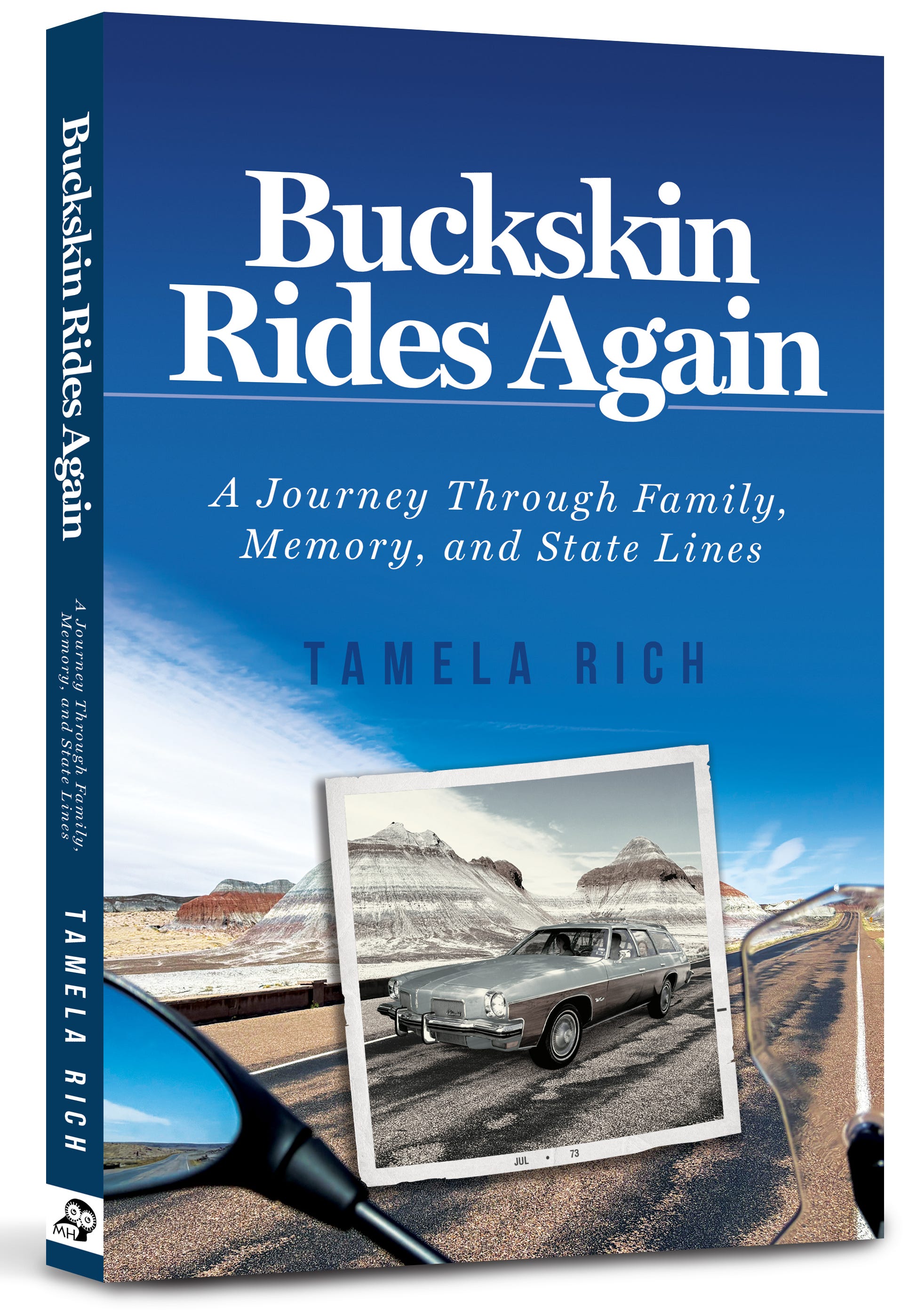
The Substack serial was a solid draft. But it took distance—and a second pair of eyes—to understand what the story was really doing to me inside.
That’s where my editor, Ethan Powsner, came in. Ethan reads each sentence backward and forward just to make sure nothing slips through. This can be unnerving at first—but invaluable once you trust it.
What he’s really doing, though, is reading for coherence—for the shape of the story beneath the sentences. As we moved into layout, his notes started to reveal patterns I couldn’t see from inside the writing, plus some writerly quirks and habits I needed to revisit.
You might be wondering: Tamela, if you’re an editor, why couldn’t you do this for yourself?
The answer is perspective. No one sees their own work with full clarity. Over the course of a 60,000-word book, it’s easy to miss what’s unclear, what’s assumed, or what contradicts something you wrote fifty pages earlier. The reader needs an advocate—someone who can see the gaps before the book goes out into the world. Ethan is your advocate in Buckskin.
Here are a couple of examples from Ethan’s first pass at the designed pages, which I will say, is a very different experience than looking at your book in a word processing application.
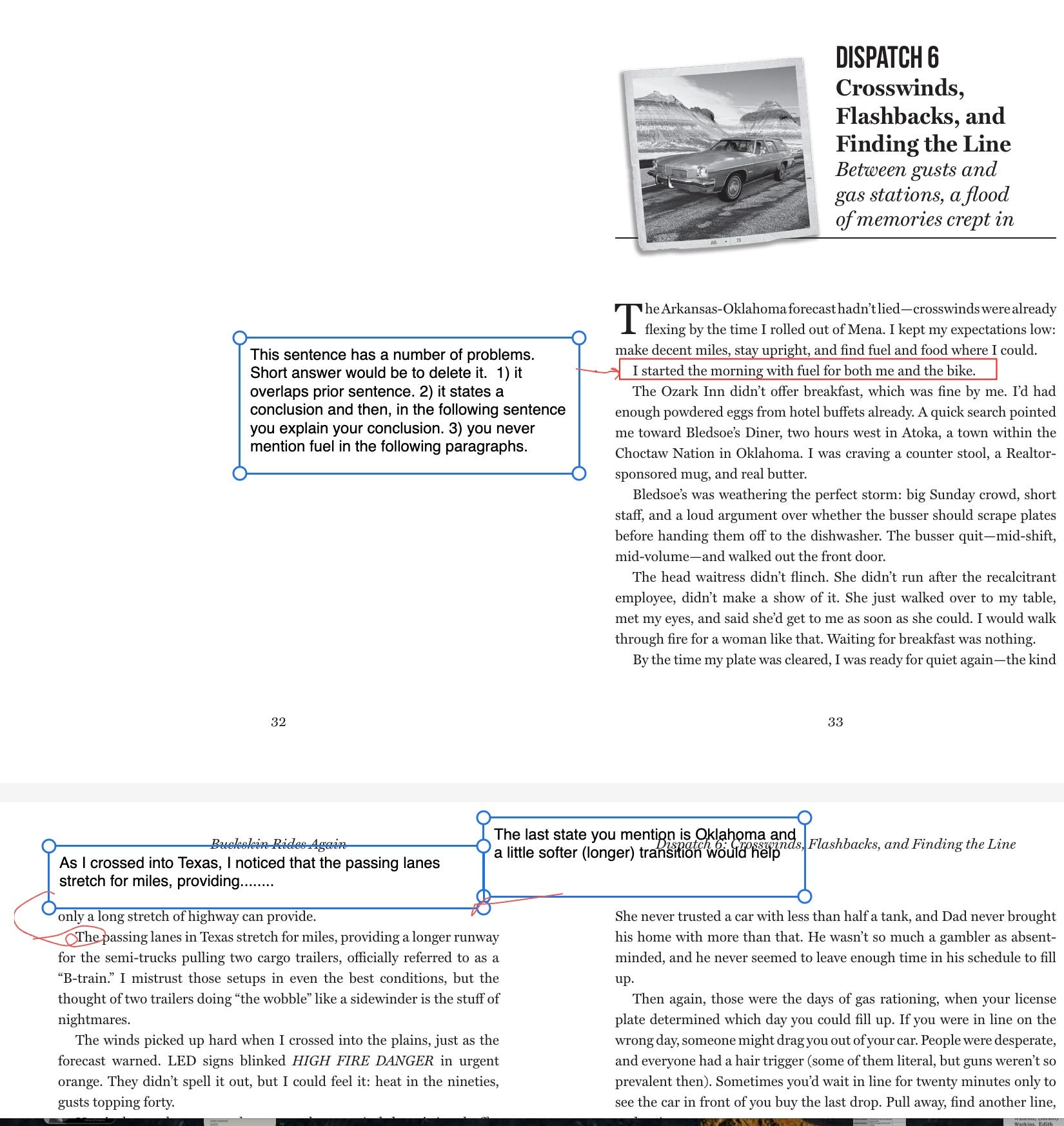
See how he explains a problem and suggests a way out? Notice how he read the dispatch for continuity, then told me I needed a transition from Oklahoma to Texas? Solid gold editing.
Of course we didn’t agree on everything, but working with a trusted editor means that when I chose a different direction, I did it deliberately. I could justify the decision. The conversation sharpens the work—even when I don’t take the suggestion.
What changed between the dispatches and the book isn’t just polish. Scenes are more fully realized. Emotional threads carry across chapters instead of appearing and disappearing. Transitions do a lot more work.
And in a few places, I finally understood what I was writing about—after the fact. Those are the sections that deepened the most.
What surprised me most was how much the meaning shifted—not because the events changed, but because I could finally sit still long enough to understand what they added up to.
Distance does that. Time does that.
The Substack series was written with all the clarity and limitation of a first pass. The book is what emerged after.
If you rode along last year, you know the terrain. The book is where it lands and what it meant.
Inherited Laundry Tips
I wrote quite a bit about my grandparents in Buckskin—the lives they lived, and the habits that came with them. My mamaw made nearly everything by hand, including socks and sweaters, or she made do without.
I remember helping Mamaw with laundry in her cellar. I was maybe five. My arm went straight through the wringer’s two rollers along with the sheets I was helping her feed through them. Before I could even get my dander up, she stopped, reversed direction, and I was good as new. No hollering or histrionics. What a woman.
I felt safe in her care and benefitted from her unfailing good sense, which is why I dedicated Buckskin to her.
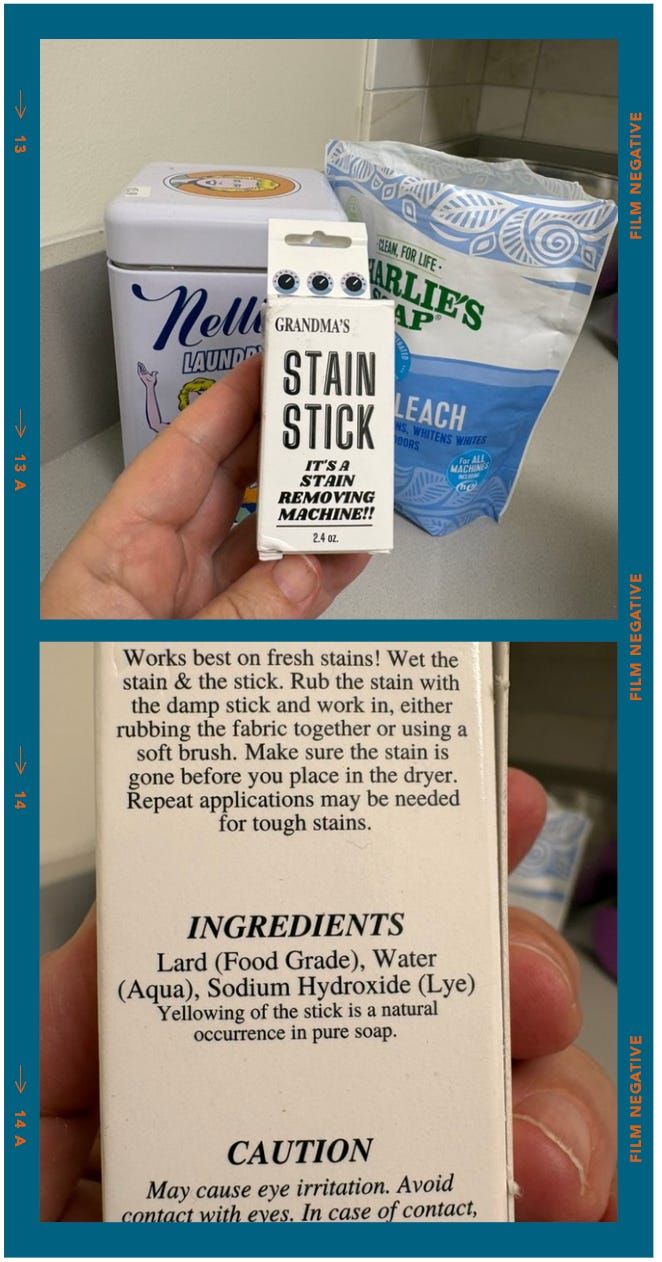
I’m always on the prowl for eco-friendly products that work as hard as eco-killers, and if something is marketed to me as “Grandma’s” I’m on it like a kitten to catnip. Enter Grandma’s Stain Stick.
Seeing this little stick—lard, water, and lye—I couldn’t help but think Mamaw probably had her own version of it somewhere in the house. Not branded or packaged, but nonetheless effective.
I tried it on a pair of my hubby’s golf shorts after they’d been through the wash a time or two, figuring the mystery stain had long-since set. But it came right out with Grandma’s Stain Stick!
I got the stick at my local hardware store in Charlotte, North Carolina. Here’s a link if you don’t want to make the drive.
And yes, in the picture, left of the stain stick is a tin-clad metal can of Nellie’s Washing Soda (from Canada!). That can’s lid is sealed with compostable cork for an airtight seal (I hate clumpy laundry products!). Love the product after a couple of years. To the right of Nellie’s is Charlie’s Oxygen Bleach (non-chlorine).
All of these products are scent-free. There are stores I can barely step into anymore—candles burning, those automatic scent machines puffing away—and my lungs just stop cooperating. I don’t ever remember having this reaction as a kid in Mamaw’s cellar, as she who turned out laundry that gleamed without the sniff test.
Got a laundry tip from your grandmother? Bring it on and I’ll share it next week.


